


07 Oct Find a note-taking system that works for you
Writing notes comes down to preference; different systems suit different styles.
You may have just gone back to school, started your degree, or face having to get back into work mode after a long relaxing holiday. Whatever your situation, it’s time to sit up and take note. Note-taking can help you succeed academically and within a business environment.
There are a number of note-taking systems that have been devised by scholars, academics and business aficionados. But which system is the best? This comes down to each individual note-taker; different systems suit different styles. Outlined below are just a few options that may fall in line with your preferred note-taking approach.
The Cornell System
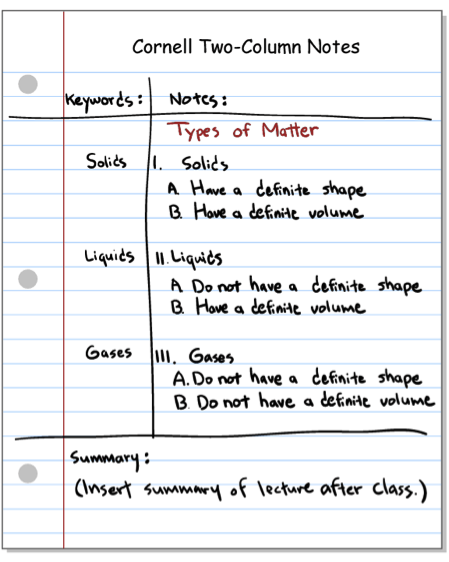
This method provides a systematic format for organising and structuring your notes. Your paper is divided into three sections: one for the bulk of your notes, one for writing key concepts and questions, and another for reflecting upon and summarising your argument (see example below. Source: Fontana Middle School Wiki).
The main bulk of your notes should be written in the largest note-taking column. This will usually consist of your main ideas or the key content from a meeting or lecture. Notes should be paraphrased as much as possible, with long sentences avoided, using symbols and abbreviations.
You should consider any questions or highlight any definitions in the left hand column. This encourages active note-taking, as you are thinking about how these notes may be useful to your future development.
Research has suggested that notes are most effective if they are revisited at a later date. The bottom column can be used for answering questions you may have jotted down, or for summarising the main argument of the lecture or meeting. This increases the understanding of a topic, helping to retain it more successfully.
This approach is used frequently within both academic and business settings. One high profile advocate of the Cornell System is Bill Gates. There are countless reports of Gates using this system in meetings, furiously scribbling down any questions he has at the bottom of his page.
SQ3R
This method is based on reading comprehension, named after its five steps: surveying, questioning, reading, reciting, and reviewing. The system was advocated by Francis Pleasant Robinson in his 1946 book Effective Study, based on principles documented in the 1930s.
SQ3R is used mainly within an academic setting, but can be adapted to suit a more business-oriented environment, helping to build a framework of understanding based upon reading.
The first step is to “survey” the text. You should resist reading the text straight away, but rather glance through it briefly, identifying headings, sub-headings, and any other outstanding features. This will help you to recognise the text’s key concepts.
Questions should be created based on the content you’ve just skimmed through. You should try and convert the outstanding features and main headings into questions that you feel need answering.
When you begin to read the text more thoroughly, you will be actively thinking about the questions formulated in the previous process. This will ensure that you are not just passively engaging with your notes; you are thinking about how what you are reading is relevant.
The second “R” refers to the process known as recite or recall. Using key phrases, you should begin to identify major points and answers to questions from the “Q” step. This may be done either in an oral or written format. It is important that you use your own words to evoke the active listening quality of this method.
The final “R” calls for a review of the content. You should be able to test yourself by attempting to recite the key themes. This allows an individual to test how familiar they are with their notes, making SQ3R an excellent revision tool.
Mind mapping
If you are the sort of note-taker who prefers less linear methods, mind mapping may be for you. In this system, ideas are written in a tree-like structure, with lines interconnecting related ideas. An example mind map is shown below (source: Wikipedia).

Mind maps are drawn from a central point, which usually denotes a key theme or topic. From this centre goal, the individual will then have multiple branches coming off in order to display the related information. This method allows you to easily show how different topics are linked, essential when aiming to think analytically or critically about a topic.
Colours, illustrations, and symbols are often used to help visualise the content more easily. This note-taking method is therefore more common among visual learners. Mind maps are useful for summarising a large amount of information when revising for an exam or planning an essay.
Put pen to paper with NoteShel
If you want to sample one or all of these systems for yourself, start with the right equipment. Our stylish refillable Post-it® Note holders are the perfect note-writing solution at work, at home, for studying, and on the go. For more information visit www.noteshel.com.
No Comments