


18 Nov Visual note taking: Nine reasons to join the doodling brigade
Doodling: pointless procrastination to fill the minutes, or a crucial activity to make the most of your time?
Many professionals and students find that doodling – or ‘visual note taking’ – is a creative, quick way to keep track in meetings and lectures, and it’s a lot more fun than writing pages of cramped, detailed notes.
Doodling isn’t just a modern day ‘gimmick’ lauded by the likes of Google employees; humans have been doodling for over 30,000 years on cave walls and in sand.[1]
Perhaps it’s time we revisited our roots and overhauled our existing system of note taking?
Here’s why you should join the club and try doodling.
1. Doodling can improve your creative thinking and cognitive performance[2] – as Sunni Brown, ‘doodling revolutionary’ says, ‘Doodling is really to make spontaneous marks to help yourself think.’ Doodling is a visual exercise that allows you to make sense of your thought process through combined imagery and text.
2. People naturally think in pictures – so a doodled image and word combo that aligns with your thought patterns might spark a stronger resonance than a plain sentence, leading to stronger recollections of key points.
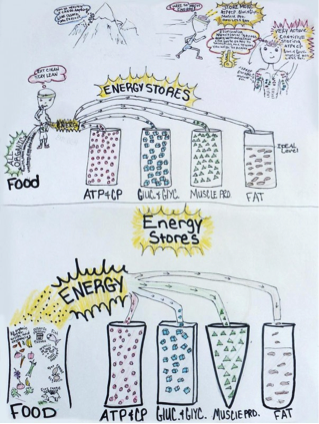
‘How the body breaks down energy’ by Veronica Wagner (Source)
3. Doodling encourages you to focus on one or two key themes, and to jot the secondary themes around them – a key tenet of successful note taking. For example, a meeting about an upcoming event might involve doodles of a signpost and address, banners, balloons and cakes, with explanatory notes jotted around them.
4. Let’s face it, it’s a lot more fun to look at a page of pictures than a page of text – and you’re more likely to revisit a page of colourful doodles than reams of careful annotations.
5. Doodlers tend to retain more of the verbal information they’re processing than non-doodlers; a study by Professor Jackie Andrade found that doodling can lead to a 29% increase in information retention. It seems that the creative aspect of the note taking helps you to absorb the information more fully than when writing down verbatim notes.
A doodle made at a TED talk by Larry Page (Source)
6. It keeps you awake! As Jackie Andrade found in her study, doodling keeps you focussed and engaged. This could be a boost for you if you regularly attend dull but important lectures or meetings.
7. Doodling can be an easier way to process heavy information, as the creative action of drawing can help to categorise and sort topics and themes.
8. It’s more efficient than plain writing, freeing up your attention to focus on the matter at hand. As Sunni Brown says, “Imagery doesn’t compete with words for your brain’s attention. It literally moves us into a different head space and allows verbal information to be taken in and better absorbed.”
9. You’ll be in good company. George Washington, Vladimir Nabokov and Bill Gates are famous doodlers[3].

‘How to buy the Internet a cup of coffee’ (Source)
Read more:
The simple power of the doodle
Note-taking, doodles and sketches from TED2014
[1]http://edition.cnn.com/2011/09/01/opinion/brown-creativity-doodles/index.html
[2] http://edition.cnn.com/2011/09/01/opinion/brown-creativity-doodles/index.html
[3] http://edition.cnn.com/2011/09/01/opinion/brown-creativity-doodles/index.html
No Comments