


16 Dec Visualize your business model with Post-it Notes
A tool for visionaries, game changers and challengers
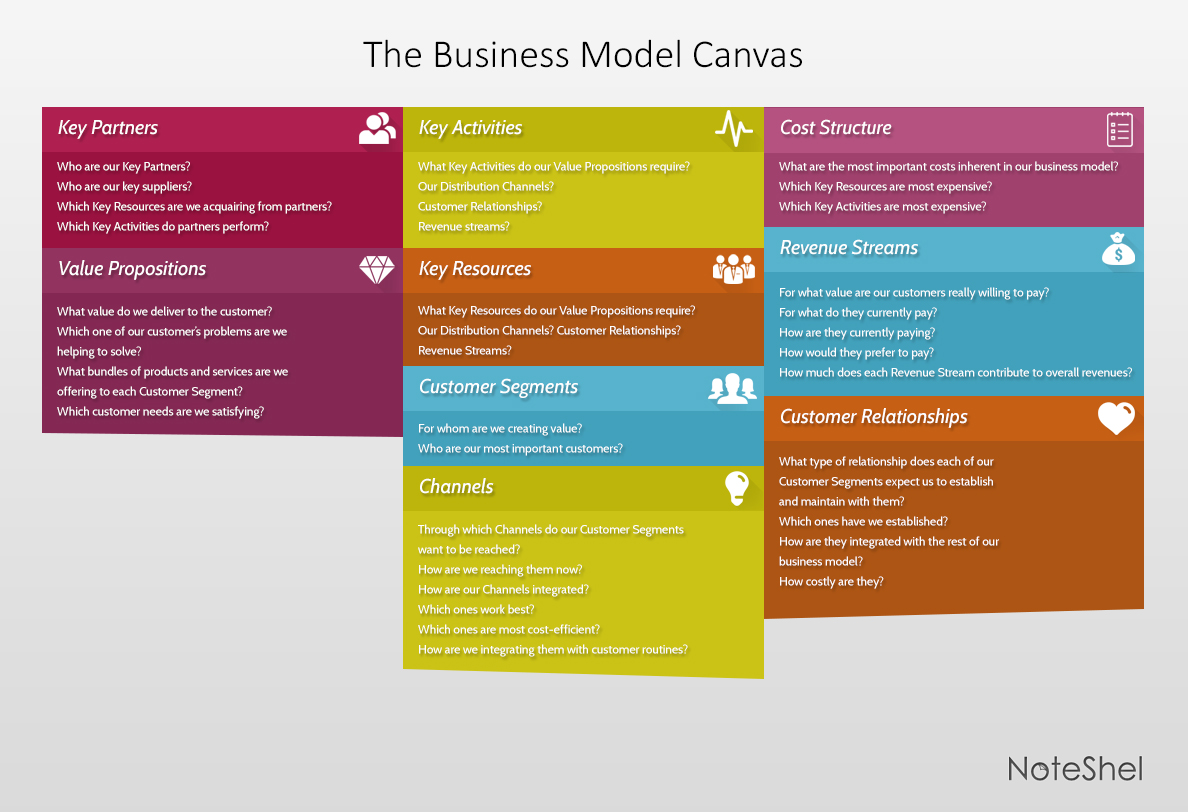
The Business Model Canvas is a strategic management outline for developing new or existing business models. It’s a simple graphical template, describing nine essential components. The individual elements prompt consideration of a business’ full potential, while the layout encourages thought about how the pieces fit together.
So what are the different elements, and how do they contribute to your company’s business model?
Customers comprise the heart of any business model. Without customers, no company can survive. In order to better satisfy customers, a company may group them into distinct segments with common needs, common behaviours, or other attributes.
2. Value Propositions
The value proposition is the reason why customers choose one company over another. It solves a customer problem or satisfies a customer need. Each value proposition consists of a selected bundle of products and services that caters to the requirements of a specific customer segment.
3. Channels
Communication, distribution and sales channels compromise a company’s interface with customers. Channels are customer touch points that play an important role in the customer experience.
4. Customer Relationships
A company should clarify the type of relationship it wants to establish with each customer segment. Relationships can range from personal to automated. Customer relationships may be driven by acquisition, retention or upselling.
5. Key Resources
These resources allow an enterprise to create and offer a value proposition, reach markets, maintain relationships with customer segments, and earn revenues. Different key resources are needed depending on the type of business model. Key resources can be physical, financial, intellectual, or human. They can be owned or leased by the company or acquired from key partners.
6. Key Activities
These are the most important actions a company must take to operate successfully. Like key resources, they are required to create and offer a value proposition, reach markets, maintain customer relationships, and earn revenues. Like with key resources, key activities differ depending on business model type.
7. Key Partnerships
Companies forge partnerships for many reasons, and partnerships are becoming a cornerstone of many business models. Companies create alliances to optimise their business models, reduce risk, or acquire resources.
8. Cost Structure
Creating and delivering value, maintaining customer relationships, and generating revenue all incur costs. Such costs can be calculated relatively easily after defining key resources, key activities, and key partnerships. Some business models, though, are more cost-driven than others.
9. Revenue Streams
A company must ask itself, for what value is each customer segment truly willing to pay? Successfully answering that question allows a business to generate one or more revenue streams for each customer segment.
A completed Canvas can be seen below, illustrating how all these elements fit together:
Now that you understand the different elements of the Business Model Canvas, how can you begin to use them to your advantage?
One for the visual learners
By sketching out all the elements of the Canvas, you immediately give viewers the bigger picture. Dialogue improves as a result of being able to visualise your model as a collective reference point.
The Business Model Canvas serves as a shared repertoire, resulting in mutual understanding and engagement. It’s arguably comparable to an artist’s canvas; it acts as a catalyst for ideas, providing the opportunity to alter the model and ignite discussion.
Collaborate with others
Post-it Notes can be used as a tool for collaborating ideas – they can be distributed with a group and placed in the relevant position on the model. In this way, the Canvas is a hands-on tool that fosters understanding, discussion, creativity and analysis.

Post-it Notes are handy as they help to facilitate mess. Each idea can be written on an individual note, ensuring that you don’t have to squeeze lots of information into a tiny box. Notes can then be stuck on top of each other, moved around, annotated, removed, or colour coded.
The perfect tool for business modelling
Keep your Post-it Notes to hand with NoteShel, the perfect accompaniment for business modelling. Make sure all your employees take advantage of this stylish Post-it Note holder and pen. Take notes on the go, at work, or in a brainstorming session. Follow us on Twitter and Pinterest and ‘like’ us on Facebook for more top tips on boosting workplace productivity.
No Comments